With so many PFAS analytical methods available, figuring out the right approach can feel overwhelming. Many of these methods overlap, but most can be grouped into two broad categories: targeted analysis and non-targeted analysis. This guide focuses on methods relevant to water and wastewater testing and offers an overview of how these approaches differ and when each may be useful.
Targeted analysis refers to measuring a pre-defined list of (usually 1 to 45) known PFAS. Because these compounds are known in advance, analytical standards are used to provide accurate, sensitive, quantitative results. In this industry, this is the "tip of the iceberg" analysis, but it has been vital for tracking the fate of specific regulated compounds such as PFOA and PFOS.
Common targeted methods for water and wastewater include:
United States:
International:
Non-targeted analysis refers to identifying PFAS without knowing their name or structure. High-Resolution Mass Spectrometry (HRMS) can be used to find new and unexpected PFAS but may be time-consuming and costly. Alternatively, Total Organofluorine analysis techniques can sum the amount of PFAS without needing to pinpoint the specific compounds of the PFAS present by measuring the mass of fluoride in all the organic molecules in a sample. TOP Assay combines targeted analysis with a technique that makes some of the difficult-to-target PFAS, targetable.
Common non-targeted methods for water and wastewater include:
United States:
International:
It’s important to remember when testing PFAS concentrations, it’s more holistic to choose between a combination of target and non-target analyses to complement one another. For instance, you can couple EPA 1633 + AOF-CIC or EN 17892:2024 + TOF-CIC for a well-rounded understanding of the PFAS in your sample.
If you want to evaluate PFAS destruction performance thoroughly, you will need to monitor the fate of the fluorine atom, specifically in mineralized fluoride end-products. You can do this by complementing your selected PFAS methods with Ion Chromatography or a Fluoride Ion Selective Electrode. Finally, any PFAS compounds in the air can be quantified with methods such as EPA OTM 45 (Volatilized PFAS) or OTM 50 (Fluorocarbons).
As mentioned earlier, these are ideally used in tandem to get a more realistic profile of PFAS in your sample due to the often referred “iceberg principle” – where different methods may capture a certain proportion of the iceberg. Another way to look at it is like measuring the quantity of stars in the sky (Figure 1).
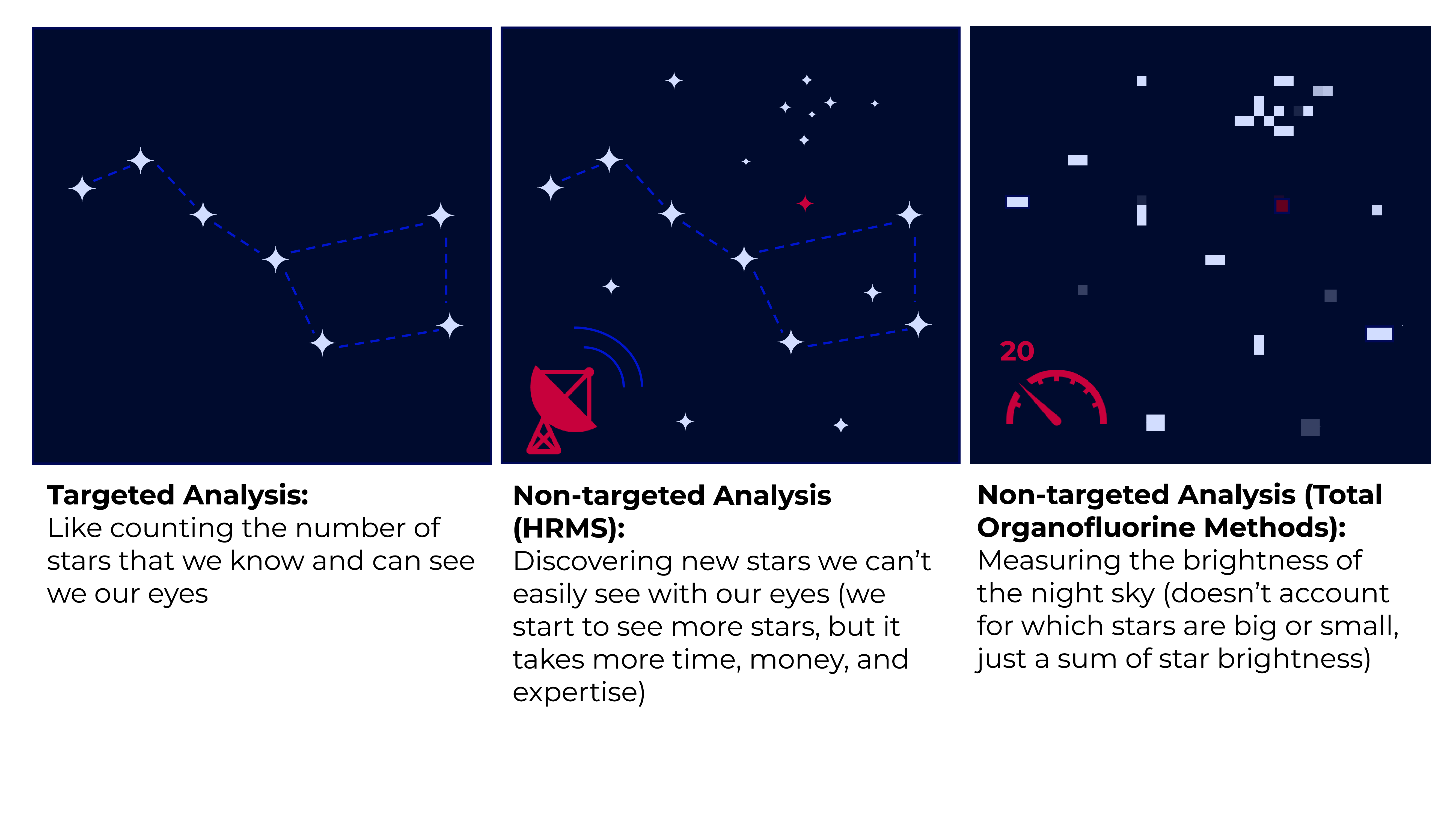
Figure 1. An illustrated analogy for Targeted and Non-targeted analysis techniques. In Targeted Analysis, we can easily see and are familiar with the Big Dipper constellation, but we know there are more stars beyond these with no name. In Non-targeted Analysis (HRMS method) we use a high-resolution instrument (like the radio telescope in this analogy), that can count stars beyond what we know about from seeing with our eyes. This works well for identifying new targets but is expensive and takes a lot of time. Finally, Non-targeted analysis via Total Organofluorine methods is illustrated here as pixelated clusters, summing the total area of “brightness” in the sample of sky, but without resolving the names or identities of these potential targets.
For example, EPA 1633 has 40 known PFAS that it measures for, and therefore only measures the amount of those 40. With over 14,000 types of known PFAS molecules, Non-targeted analysis helps us capture more PFAS, including those not yet listed, when we are concerned more about the quantity of PFAS.
Whether you are managing PFAS in an industrial process stream or evaluating treatment and destruction options, working with the right experts can make all the difference. Aquagga can help guide sample evaluation during bench-scale testing and connect you with the laboratory insights needed to better understand your PFAS challenge.
To start, decide what you want to know as your PFAS question: is it just the regulated PFAS you’re interested in knowing about, or do you want to understand what other PFAS is lurking in your sample? From there:
Connect: Ask to speak with an Aquagga representative to help understand your needs. Additionally, many labs such as Enthalpy Analytical have dedicated PFAS analysis professionals who are passionate about helping answer your PFAS sample questions regardless of your level of scientific background.
Ask the Experts: Which methods do they recommend are appropriate for answering your PFAS question?
Tell the Experts:
From there, analytical labs will provide a free sample kit along with sampling instructions such as sample volume required and storage temperature. The sample kit will contain a sample cooler, bottle-sized Ziplock bags for overpacking/sample protection, a Chain of Custody form and special PFAS-free sample bottles.
These sample bottles are important, as even food-grade plastic bottles you buy from the store can have minute amounts of PFAS, so these bottles are cleaned with a special technique for trace laboratory analysis. A Chain of Custody is vital to fill with every sample shipment to ensure the integrity of your samples and that they are not lost or tampered with.
PFAS analysis has advanced quickly over the last couple of decades, and it is still evolving. As new compounds are recognized and new methods mature, the best testing plan is the one that fits your matrix and your quality needs.
If you are unsure where to start, contact our team to discuss your feedstock and PFAS treatment goals.